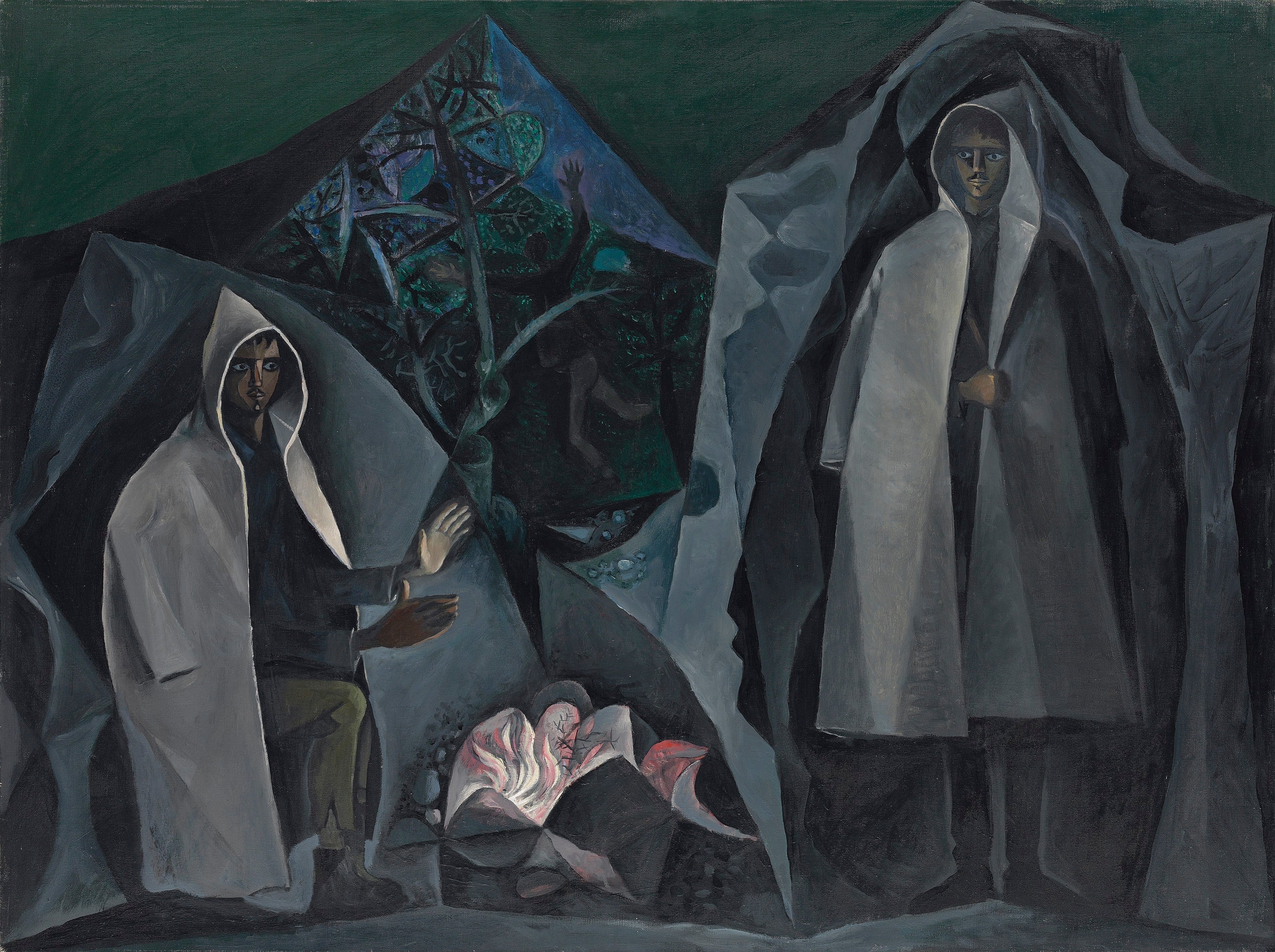
Midnight in Greece
The nocturnal paintings of John Craxton

One would consider it paradoxical to paint darkness in Greece. In a country where generations of artists struggled to master its intense light, to turn instead towards the night seems almost contradictory. Yet it is within this unexplored side of Hellenicity that John Craxton finds fertile ground to create a series of nocturnal paintings, initiating us into the Dionysian dimension of life in Greece.
Until his arrival in Greece in 1946, Craxton’s work is characterised by dark tones and claustrophobic landscapes. With the Second World War trapping him in a place simultaneously familiar and foreign, he sought an escape in the Mediterranean South that would offer him spiritual liberation. The dazzling light, as well as the architecture and landscape of Poros — the island where he spent his first months — fundamentally transformed his style. From his very first Greek painting, his work acquired the vitality, carefree spirit, and aura of life in Greece.
And yet, in 1949, Craxton produced a series of nocturnal works, overturning our assumptions about what may be considered ‘Greek’. These night scenes seem to have functioned as a temporary ‘refuge’ for the artist in his new ‘homeland’. His earlier engagement with similar themes in England rendered them familiar to him and allowed him to explore an aspect of Greece that was by no means regarded as representative of the country. Furthermore, by following the ritualistic daily life of shepherds in Crete, Craxton came to understand that the night was a continuation of life during the day, not merely its ending. Consequently, he recognised the importance of these hours for pastoral and agricultural labour, enabling him to convey the complete experience of life in Greece.
These ideas are embodied in Shepherds at Night (1949), one of his most representative nocturnal works. The artist places us in the White Mountains of Crete, where he was living among the local population during that period. We find ourselves before two natural shelters, where two shepherds have paused to rest for the night. A fire illuminates the dark landscape, faintly revealing their faces. Their gazes are distant, expressing a sense of introspection. Their cloaks, together with the low angle from which the light emerges, lend the shepherds a mystical quality, as though they were monks belonging to some obscure sect. In the background, a third figure — possibly the artist himself — runs ecstatically towards the illuminated forest. It seems as though some ancient ritual is underway, one he is trying to reach in time.
By experiencing the solitude and devotion of the shepherds, Craxton transforms a conventional pastoral subject into a depiction of followers of a secular religion. In capturing an unarticulated aspect of Hellenicity, we begin to see how the detachment perspective of an English painter exposes the one-dimensional understanding of our national identity. Let us, then, take a step back and allow Life itself to reveal once more the multifaceted nature of our homeland.